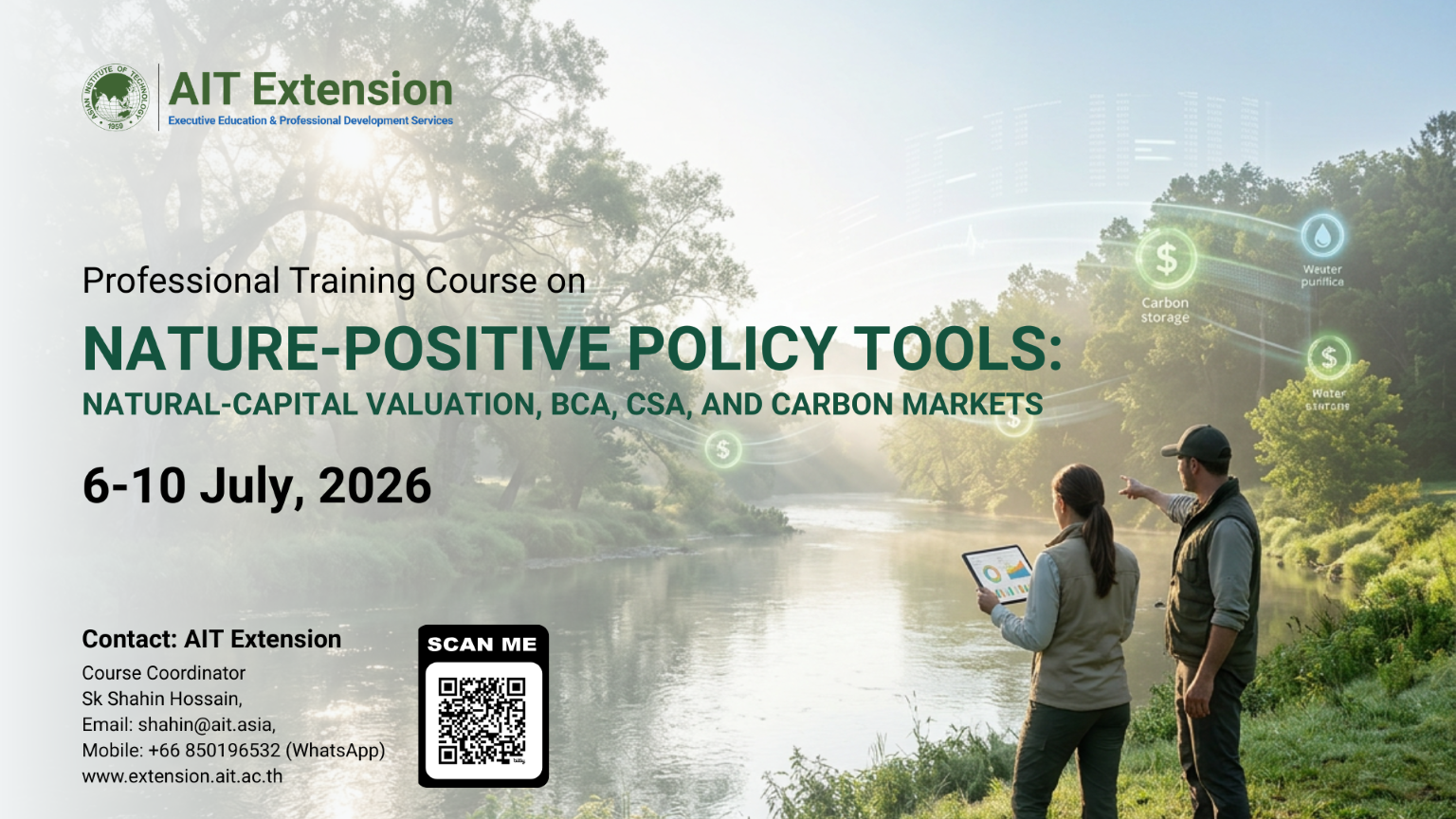
Course Introduction
Background
Public and private decisions increasingly require defensible evidence on how nature contributes to welfare, livelihoods, and economic performance. “Nature-Positive Policy Tools” responds to the practical need to quantify nature-related benefits and costs and use that evidence to design and appraise interventions. As climate change, biodiversity loss, and resource scarcity intensify, policies and investments increasingly require credible estimates of ecosystem values, trade-offs, and distributional implications.
Unlike technical carbon accounting, this course focuses on the economic valuation and policy appraisal toolkit for nature-positive action. It introduces natural capital valuation, benefit-cost analysis (BCA), and survey methods and analysis that can be applied to forests, protected areas, water resources, and climate-smart agriculture. Participants learn how valuation evidence is translated into decision-ready metrics using social cost concepts, time discounting, and sensitivity analysis, and how these outputs inform instrument design, including payments for ecosystem services (PES) and carbon market mechanisms.
Course Highlights
1. Module 1: Ecosystem Valuation: Market and non-market valuation methods, with a case on forests, national parks, and biodiversity under climate change.
2.Module 2: BCA and Survey Methods: Benefit-cost analysis (BCA) metrics and application; survey design, sampling, measurement, pretesting.
3. Module 3: Statistics in R: Reproducible workflow in R, descriptive and inferential statistics, and applied regression.
4. Module 4: CSA Policy Design: Climate-smart agriculture (CSA), adoption, and instrument design (targeting, conditionality), with a case exercise.
5. Module 5: Carbon Applied Skills & Practice. Carbon markets, project integrity concepts, measurement, reporting, and verification (MRV), and capstone presentations.
Target audience
1. Government officers and policymakers in environment, agriculture, water, and planning;
2. NGO and development agency professionals working on nature-positive projects
3. Corporate sustainability and CSR managers, including supply-chain and climate teams
4. Faculty members, researchers, and graduate students in environmental economics, sustainable agriculture, and environmental policy
5. Consultants and analysts supporting natural capital valuation, BCA, CSA, and carbon market prices
Why should you attend?
Nature-positive strategies increasingly require numbers that stand up in policy and investment decisions, instead of generic sustainability language. This course provides practical skills in natural capital valuation, benefit-cost analysis, survey design, statistical analysis in R, and the basics of climate-smart agriculture (CSA) and carbon markets, so that participants will be able to appraise programs, justify budgets, and communicate trade-offs with credible evidence across public, private, and development settings.
Key takeaways
1. Apply market-based and non-market-based methods to value ecosystems and interpret results for decision making.
2. Conduct benefit-cost analysis (BCA), with social cost concepts, discounting, and sensitivity analysis.
3. Design surveys and run reproducible statistical workflows in R.
4. Understand how valuation evidence links to climate-smart agriculture (CSA) program design and carbon market concepts, including measurement, reporting, and verification (MRV).
Format and Fees
📅 Duration: 5 Days (5 Modules)
📍 Format: In-person / Online
👥 Target Size: 15–20 participants
💰Fee:
USD 1,500 / All Modules (In-person)
USD 1,000 / All Modules (Online)
USD 300 / Each Module (In-person)
USD 250 / Each Module (Online)
🎟 Early Bird (Before 7 June, 2026) & Group Discounts Available (e.g. Enroll 3 colleagues, get 20% off), including Accommodation + Meal for those who enroll for all 5 Modules.
👉 Enroll today and gain the skills of Nature-Positive Policy Tools
👉 Highly welcome to the AIT Alumni Community
Contact: AIT Extension
Course Coordinator
Sk Shahin Hossain
Email: shahin@ait.asia
Mobile: +66 850196532 (WhatsApp)